


When planning an ocean monitoring project, one of the first decisions to make is choosing the right type of buoy system. Among the most commonly used options are drifting buoys and moored buoys. While both are designed to collect marine data, they serve different purposes and are suited to different environments.
Understanding the difference between a drifting buoy and a moored buoy can help ensure that your monitoring system delivers the data you actually need.
A drifting buoy, as the name suggests, is designed to move freely with ocean currents. It is not fixed to the seabed and instead follows the natural movement of the water. This type of buoy is often used in large-scale ocean studies, where researchers want to understand current patterns, surface temperature distribution, or the movement of water masses over time.
Because drifting buoys travel with the current, they are able to cover a wide geographical area. This makes them particularly useful for collecting data across regions that would otherwise be difficult to monitor using fixed equipment. In many cases, multiple drifting buoys are deployed at once to create a broader data network.

Drifting buoys are also commonly equipped with GPS systems, allowing their position to be tracked in real time. This location data is often just as important as the environmental data they collect, especially in studies related to ocean circulation or climate patterns.
On the other hand, a moored buoy is anchored to the seabed using a mooring system. This typically includes cables, chains, and anchors designed to keep the buoy in a fixed position. Because of this, moored buoys are ideal for long-term monitoring at a specific location.
For example, in applications such as water quality monitoring, offshore platforms, or port environments, it is important to collect consistent data from the same point over time. A moored buoy allows for this type of continuous observation, making it easier to identify trends and changes in local conditions.
Moored buoys are also widely used in wave monitoring. A wave buoy fixed in position can provide stable and continuous measurements of wave height, wave period, and wave direction. This is particularly useful for offshore engineering projects, where accurate and location-specific wave data is required.
When comparing the two types, mobility is one of the main differences. Drifting buoys are mobile and suitable for studying movement and distribution, while moored buoys are stationary and better suited for fixed-point monitoring.
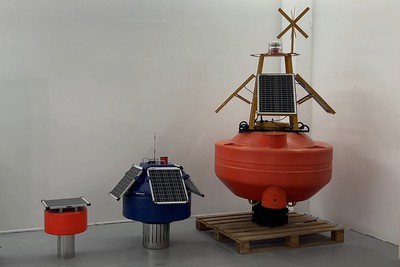
Another important factor is deployment complexity. Drifting buoys are generally easier to deploy, as they do not require anchoring systems. In contrast, moored buoys require more planning and equipment during installation, especially in deeper waters or areas with strong currents.
However, this added complexity also brings stability. Once deployed, a moored buoy can remain in place for extended periods, providing consistent data without the variability caused by movement.
In some cases, wave buoys and monitoring buoys can be designed to function in either mode, depending on project requirements. For example, a wave buoy used for regional studies may be deployed as a drifting system, while one used near offshore infrastructure is more likely to be moored.
Choosing between a drifting buoy and a moored buoy ultimately depends on the goals of the project. If the objective is to understand large-scale ocean dynamics, a drifting buoy may be the better choice. If the focus is on long-term monitoring at a specific site, a moored buoy is usually more suitable.
Budget, environmental conditions, and data requirements also play a role in this decision. In many real-world applications, a combination of both types may be used to provide a more complete picture of the marine environment.
As ocean monitoring continues to develop, both drifting and moored buoys remain essential tools. By selecting the right type for your application, you can improve data quality and make your monitoring efforts more effective.