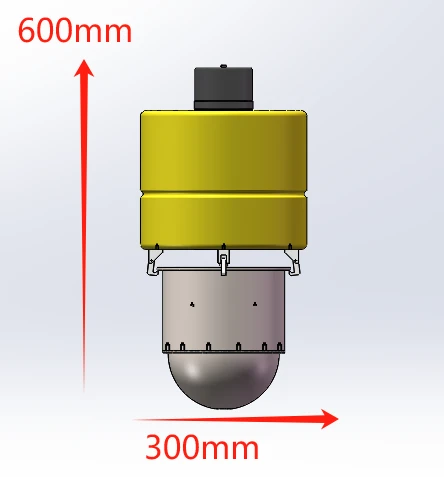
Given the growing global concern about deep-sea resources, climate change, and marine ecosystems, subsurface moorings, a crucial tool for underwater observation, are undergoing a profound technological revolution. The subsurface moorings of the future will not only be smarter but will also feature self-organizing network communication capabilities and will even be fully recyclable, significantly improving the efficiency of ocean observation and environmental sustainability.
Challenges of Conventional Subsurface Moorings
Subsurface moorings are typically anchored to the seabed and operate in extreme conditions, where they must withstand high pressure, low temperatures, and severe corrosion. Conventional moorings rely on batteries that typically last only one or two years and must be periodically recovered to obtain data, which is inefficient. Furthermore, real-time communication for moorings is difficult, and data transmission is performed using expensive satellite or sonar systems, limiting their application in dynamic monitoring. Furthermore, conventional moorings are typically designed for single use and can become marine debris, threatening the ecosystem after disposal.
These challenges are driving scientists and engineers to explore more advanced technologies to make subsurface moorings intelligent, self-organizing, and recyclable, thereby meeting the growing demands of ocean monitoring.
Intelligence: From Passive Data Acquisition to Active Sensing
Intelligence is critical for future deep-sea submersibles. By integrating artificial intelligence (AI) and low-power sensors, submersibles can transition from passive data acquisition to active environmental sensing. For example, new submersibles can be equipped with multifunctional sensors to monitor seafloor earthquakes, chemical concentrations, and biological activity in real time. Integrated AI algorithms can perform preliminary data analysis to detect unusual events such as underwater volcanic eruptions or ocean heatwaves.
Intelligence is also reflected in the autonomous decision-making capabilities of submersibles. For example, some submersibles can adjust their sampling rate to environmental changes, improving data resolution and saving power during critical events. In 2024, the Japan Agency for Ocean-Earth Science and Technology unveiled a smart submersible that uses artificial intelligence to predict changes in ocean currents and dynamically adjust its position to optimize data acquisition. This capability significantly improves the submersible's adaptability in complex deep-sea environments.
Self-Organizing Networks: Building Deep-Sea Communication Networks
Currently, deep-sea submersibles communicate using intermittent acoustic or surface relay stations. In the future, they will use wireless underwater communication technologies (such as sound waves and blue-green lasers) to create self-organizing networks. These networked submersibles can transmit data to each other, forming an underwater observation network. Even if a single device fails, other nodes can cooperate to maintain data transmission and monitoring. This significantly improves the robustness and coverage of the system. This is especially important for covering complex regions such as deep-sea canyons, mid-ocean ridges, and polar regions.
The intelligent, self-organizing, and recyclable design of deep-sea submersibles represents a significant advancement in ocean monitoring technology. These innovations not only improve the efficiency and reliability of data collection but also pave the way for sustainable ocean management. As technology advances, deep-sea submersibles will be a valuable tool for exploring the mysteries of our planet and contributing to the harmonious coexistence between humans and the ocean.