


In modern ocean observation, Wave Buoy Sensors have become an essential tool for obtaining dynamic ocean data. They not only "hear" the sound of waves but also "see" changes across the entire ocean surface. Many people wonder: Can a small buoy truly monitor wave changes across a vast ocean area? And just how large is its monitoring range?
First, the Wave Buoy Sensor's monitoring capabilities aren't limited to a single point; rather, they achieve wide-area monitoring based on high-precision inertial navigation and dynamic algorithms. Our sensor buoys are equipped with a nine-axis MEMS-IMU unit that captures wave acceleration, velocity, displacement, and attitude changes. This data is calculated in real time by an STM32 microprocessor and proprietary ocean dynamics algorithms to generate multi-dimensional parameters such as wave height, period, directional spectrum, and energy spectrum, creating a three-dimensional image of wave dynamics. In other words, while the buoy floats at a single point, it can deduce the overall patterns of wave motion across that area.
Secondly, in terms of spatial coverage, the Wave Buoy Sensor's monitoring coverage can extend over several kilometers or even wider ocean areas. This is because wave propagation is continuous and directional. By analyzing the multi-band wave energy spectrum, the sensor can infer the wave energy and directional distribution in the surrounding area. For example, when the buoy detects changes in wave energy at different frequencies, the system can determine the source of distant wind waves or swells, achieving a "point-by-point measurement, area-by-area" approach. This makes it highly valuable in marine meteorological forecasting and sea condition assessment.
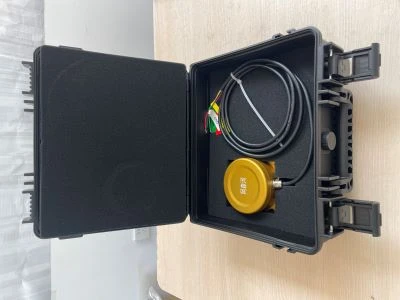
More importantly, the Wave Buoy Sensor can be deployed in a coordinated manner to expand its observation range. Multiple sensor buoys operate simultaneously in different areas, and data is uploaded to a cloud platform in real time via satellite or wireless networks, forming a comprehensive ocean monitoring network. This systematic deployment provides real-time insights into the spatial distribution of ocean wave energy, enabling regional and even national-level ocean monitoring capabilities.
Over time, the Wave Buoy Sensor also demonstrates remarkable durability. Thanks to its low power consumption and solar-powered system, the buoys can operate continuously at sea for months or even over a year, continuously collecting data. This "long-term, wide-range" monitoring capability makes it irreplaceable in fields such as marine disaster prevention and mitigation, climate research, waterway safety, and offshore wind power monitoring.
Furthermore, the system boasts exceptionally high data resolution: wave height measurement ranges from 0–25 meters, period from 1–25 seconds, and direction from 0–360°, with accuracies better than ±3%, ±0.2 seconds, and ±5°, respectively. This means it can not only see farther but also more accurately, ensuring high accuracy even in complex sea conditions.