


In modern ocean monitoring, data accuracy is a core concern for all users. Whether it's scientific research institutions, port authorities, or new energy developers, everyone desires continuous, reliable, and precise data to inform their decisions. So, just how accurate is the data provided by Remote Operated Buoys?
In terms of wave monitoring capabilities, our company's Remote Operated Buoys are equipped with industry-leading high-precision sensors, capable of monitoring wave heights between 0.01 and 25 meters with an accuracy of up to ±3%. This compares to the typical ±5% accuracy of commercially available systems. This means that under the same sea conditions, our buoys can provide more detailed wave information, not only detecting subtle fluctuations but also maintaining data reliability even in extreme weather conditions. This advantage is crucial for storm surge warnings and scientific modeling.
In terms of sampling frequency, our buoys utilize a high-frequency sampling rate of 10Hz, capable of transmitting up to 9,000 data records in a single transmission. Common commercial systems typically operate at only 4Hz, which can result in data gaps or delays in complex sea conditions. The advantage of high-frequency sampling is that it captures richer wave details, enabling scientific research institutions to conduct in-depth research on multi-dimensional parameters such as wave spectrum, wave direction, and wave period. In other words, our buoys not only tell you "how big the waves are," but also precisely describe "where the waves originate and how they behave." This undoubtedly provides users with more efficient and accurate observation data.
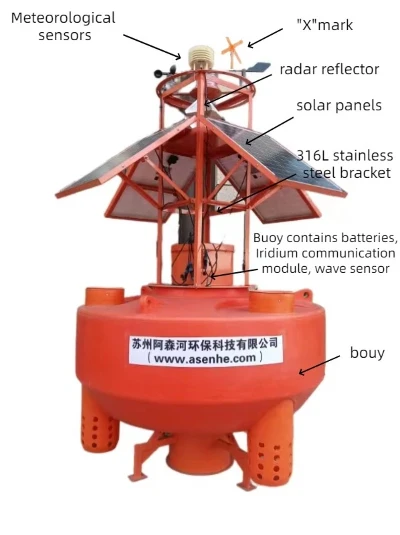
Our Remote Operated Buoy also supports separate measurement of wave spectrum and wave direction, which is not possible with many ordinary buoys. While many devices only provide basic parameters, our buoys provide research teams and engineering projects with more complete data dimensions, helping users make more informed decisions. For example, in offshore wind farm construction, separated wave spectrum data can better assess the impact of wave energy on wind turbine foundations, thereby reducing engineering risks.
From a customer perspective, high-precision data not only means more reliable scientific research but also directly impacts operational costs and safety. Accurate early warnings reduce the probability of accidents and avoid costly losses; high-quality data reduces the need for secondary data collection and repeated verification, enabling more efficient decision-making. This is the true value of our products: they provide not only data but also peace of mind and assurance.
Choosing our Remote Operated Buoy gives you:
Industry-leading wave height measurement accuracy of ±3%;
A sampling rate of up to 10Hz ensures data integrity and continuity;
Multi-dimensional monitoring, enabling separation of wave spectrum and wave direction.