


With the rapid development of marine observation technology, research institutions, marine engineering firms, and waterway management departments have an increasing demand for wave data. While traditional buoys can record some wave height and period information, they cannot meet the needs for in-depth analysis of wave frequency, directional spectrum, and energy spectrum. Therefore, the Wave Spectrum Buoy is becoming a key piece of equipment for the next generation of marine observation.
Our company's Wave Spectrum Buoy, based on high-precision inertial navigation, a self-developed marine dynamics algorithm, and a low-power platform, has significant advantages in wave spectrum measurement technology and is one of the most stable wave spectrum buoys in the domestic industry.
What is a Wave Spectrum Buoy?
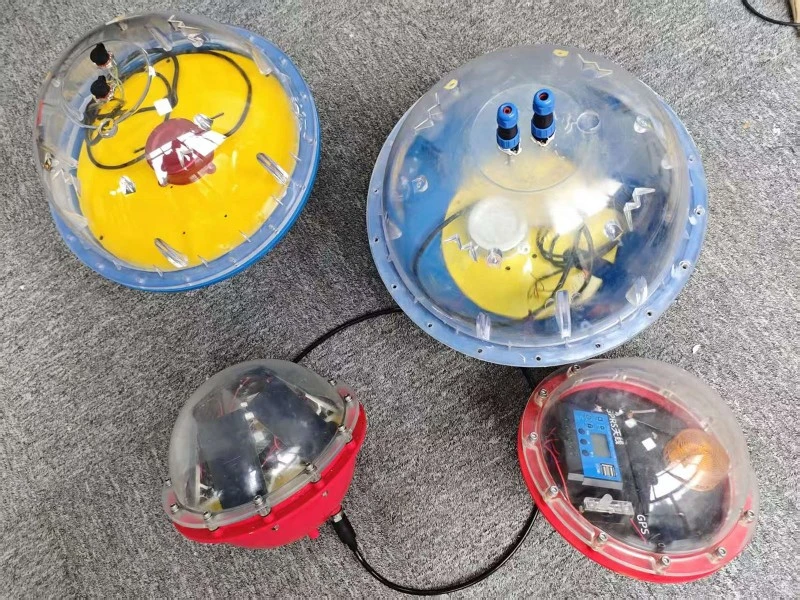
A Wave Spectrum Buoy is a high-precision wave buoy specifically designed for monitoring the wave spectrum, directional spectrum, and energy spectrum. It can collect real-time data on ocean surface displacement, velocity, acceleration, and attitude changes, and calculate complete wave elements through intelligent algorithms.
Our products utilize:
Nine-axis MEMS-IMU inertial sensor
STM32 high-performance, low-power microprocessor
Advanced wave spectrum calculation and error compensation algorithms
Corrosion-resistant, lightweight floating structure
Sustainable long-term stable operation under various sea conditions, suitable for applications in nearshore, port, deep-sea, and scientific research missions.
Why choose our Wave Spectrum Buoy?
1. High precision from nine-axis MEMS inertial navigation
The system uses acceleration, angular velocity, and attitude fusion algorithms to accurately reconstruct three-dimensional motion of the sea surface, achieving millimeter-level displacement measurement.
2. Exclusive ocean dynamics algorithm to solve cumulative error and low-frequency instability problems
Traditional wave spectrum calculations suffer from drift due to acceleration integration, while our algorithm:
Automatically compensates for acceleration bias
Eliminates cumulative velocity integration errors
Maintains high stability in the 0.04Hz low-frequency range
Ensuring accurate and reliable wave data.
3. Intelligent Separation of Wind Waves and Swells
The system can distinguish between wind waves and swells, outputting:
Energy Spectrum
Directional Spectrum
Significant Wave Height and Period
Suitable for scientific research, wind power sea trials, port design, and other applications.
4. Low-Power Platform with Strong Long-Term Deployment Capability
Average current < 50 mA, enabling long-term floating observation.
5. Lightweight Structure and Convenient Deployment
The float is made of corrosion-resistant and UV-resistant composite materials, making it lightweight, easy to transport, and deployable by a single person.
6. Full-parameter wave observation capability
Real-time output:
Significant wave height Hs
Maximum wave height
Average/1/3/1/10 wave height and period
Spectrum (0.04–1.0Hz)
Directional spectrum (0–360°)
Frequency–Direction–Energy 3D spectrum
Main application scenarios
1. Marine scientific research and university experiments
Accurately captures changes in wind wave and swell energy, providing data support for marine dynamics research.
2. Offshore wind power and marine engineering
Wave spectrum data is a key parameter for offshore wind power design and foundation calculation.
3. Port and waterway safety management
Used for ship scheduling, port construction design, and waterway safety.
4. Coastal erosion and disaster early warning
Monitoring extreme sea states, storm surges, and swell propagation.